3D Printing & Additive Manufacturing in the Chemical Industry
How additive manufacturing is creating new possibilities in chemical plant design — from rapid prototyping of reactor components to custom catalytic structures and advanced microreactor technology.
Vasudev Chemo Pharma
ISO 9001:2015 Certified Manufacturer of Industrial & Specialty Chemicals
Additive Manufacturing Meets Chemical Engineering
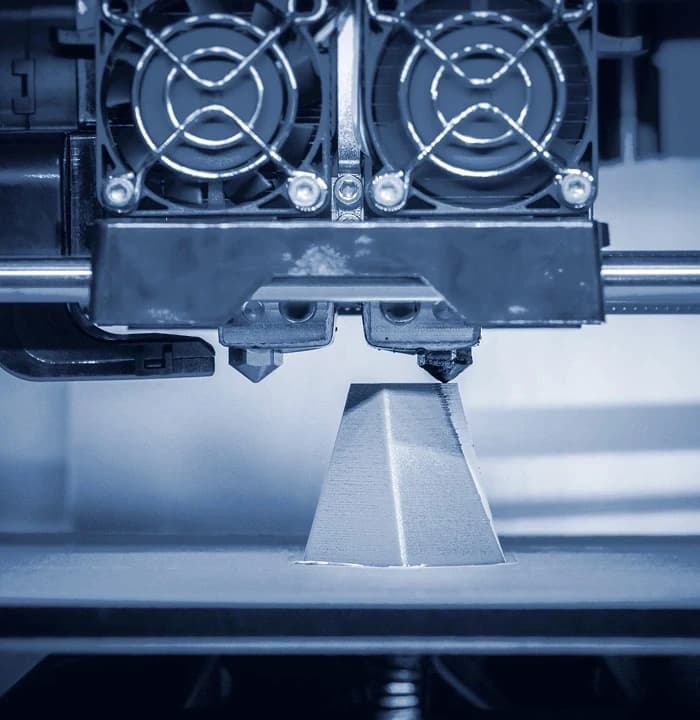
3D printing — formally known as additive manufacturing (AM) — is no longer limited to prototyping consumer products. The chemical industry is discovering transformative applications for AM technology, from printing custom reactor components with complex internal geometries to creating novel catalytic support structures with precisely controlled surface areas. Unlike traditional subtractive manufacturing, additive processes build parts layer by layer, enabling designs that would be impossible to machine conventionally. This design freedom is particularly valuable in chemical engineering, where optimising fluid flow, heat transfer, and mass transfer often requires intricate internal channel networks.
- Rapid prototyping from design to tested part in 48 hours
- Complex internal geometries impossible with traditional machining
- 3D-printed catalytic structures improving reaction efficiency 15–40%
- Microreactor fabrication for safer handling of hazardous intermediates
Rapid Prototyping for Chemical Equipment
Developing new chemical processes traditionally requires expensive and time-consuming fabrication of prototype equipment — custom reactors, mixers, heat exchangers, and separation devices. 3D printing compresses this development cycle dramatically: a reactor concept can be designed in CAD software on Monday, printed on Tuesday, and tested with actual chemicals by Wednesday. This rapid iteration capability is invaluable for process R&D teams working on new synthesis routes for products like pharmaceutical intermediates or specialty chemicals. Metal AM technologies, including selective laser melting (SLM) and electron beam melting (EBM), now produce parts in stainless steel, Hastelloy, and titanium that are suitable for actual process service, further blurring the boundary between prototype and production.
3D-Printed Catalytic Structures
One of the most exciting applications of AM in chemistry is the creation of structured catalysts with precisely engineered geometries. Traditional catalyst pellets and granules have limited control over fluid flow distribution and often create pressure drop challenges in reactors. 3D-printed catalyst supports — lattice structures, monoliths with optimised channel geometries, and TPMS (triply periodic minimal surface) architectures — maximise the contact between reactants and catalyst while minimising pressure drop and ensuring uniform flow distribution. Research published in Chemical Engineering Journal and Nature Catalysis demonstrates that 3D-printed catalytic structures can improve reaction rates by 15–40% compared to conventional packed beds, with particular benefits for exothermic reactions where precise temperature control is critical.
Microreactors and Flow Chemistry
Microreactors — miniaturised chemical reactors with channel dimensions typically below 1 mm — offer extraordinary advantages for chemical synthesis: precise temperature control, excellent mixing, inherent safety through small holdup volumes, and the ability to operate at conditions (high temperatures, high pressures) that would be dangerous in conventional batch reactors. 3D printing enables the fabrication of complex microreactor designs with integrated mixing elements, heat exchangers, and separator stages in a single monolithic block. This technology is particularly relevant for the synthesis of hazardous intermediates where minimising operator exposure is paramount, and for high-value pharmaceutical applications where precise reaction control directly impacts product purity and yield.
The Road Ahead: Material Innovation and Scale-Up
The continued advancement of 3D printing materials — corrosion-resistant alloys, high-performance ceramics, and chemically inert polymers like PEEK and PTFE composites — is expanding the range of chemical processes that can benefit from additively manufactured components. Scale-up remains a key challenge: while current AM systems excel at producing custom parts and low-volume components, achieving the throughput needed for mass production requires advances in print speed, build volume, and post-processing automation. Despite these challenges, the trajectory is clear: additive manufacturing will become an increasingly standard tool in the chemical engineer's toolkit, complementing traditional fabrication methods and enabling innovation in process design that was previously impossible.
"3D printing is not just changing how we make chemical equipment — it is changing what we can make. The freedom to design without traditional manufacturing constraints is unleashing a new era of innovation in chemical reactor design, catalysis, and process intensification."
Related Products & Services
Additive manufacturing is opening new frontiers in chemical engineering, enabling designs and processes that were previously impossible or prohibitively expensive. As material options expand and printing technologies mature, we expect to see AM components become standard elements in chemical plants worldwide. Vasudev Chemo Pharma stays at the forefront of manufacturing innovation, continuously evaluating and adopting technologies that improve our production capabilities and the quality of chemicals we deliver to customers across every industry.