H2S in Natural Gas Pipelines: Risks, Regulations, and Removal Methods
Hydrogen sulfide in natural gas pipelines causes corrosion, safety hazards, and regulatory non-compliance. This guide covers H2S risks, OSHA/NACE regulations, and the most effective removal methods including triazine chemical scavenging.
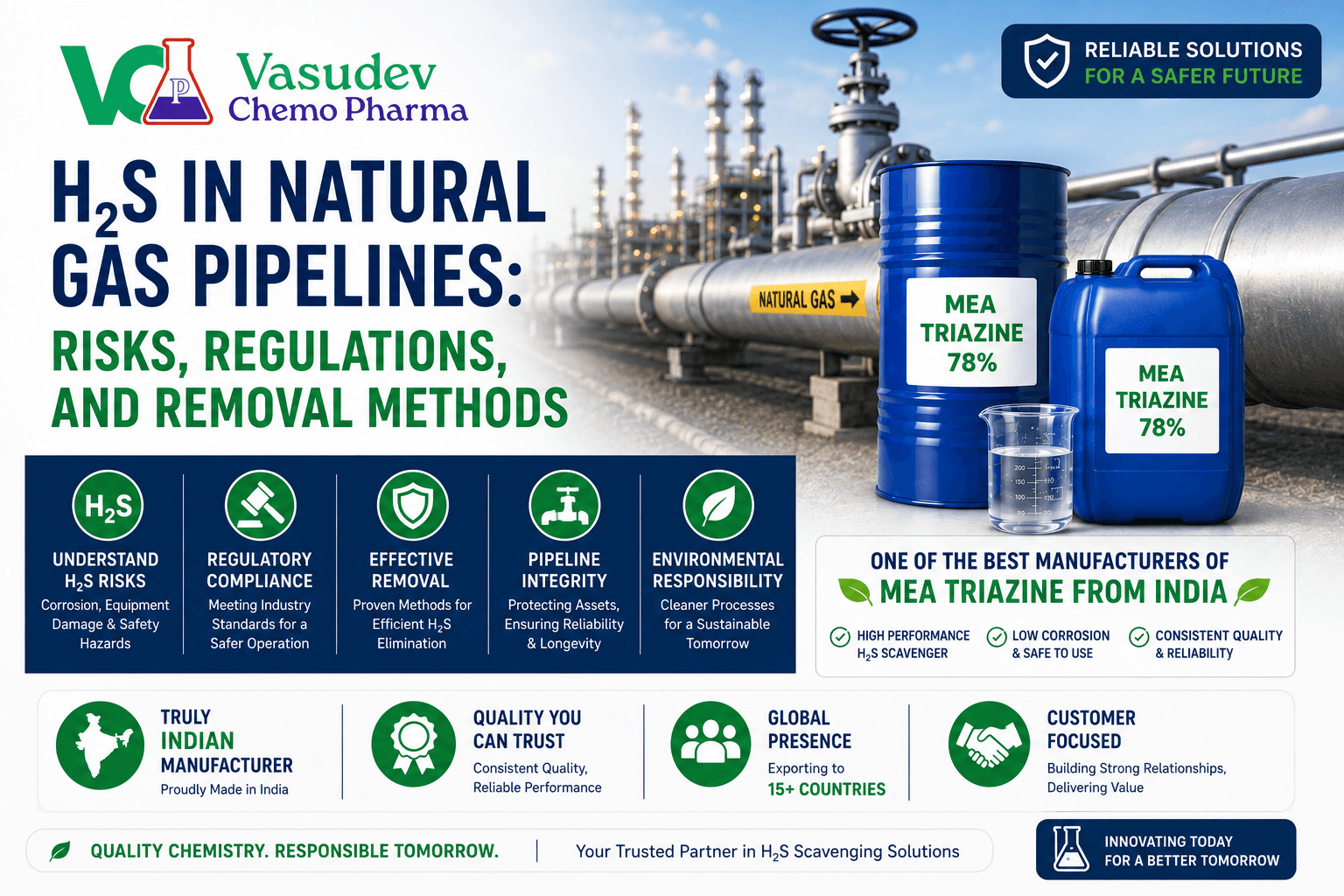
Vasudev Chemo Pharma
ISO 9001:2015 Certified Manufacturer of Industrial & Specialty Chemicals
Understanding H2S in Natural Gas Systems
Hydrogen sulfide (H2S) is a naturally occurring contaminant in many natural gas reservoirs worldwide. Formed through the thermal decomposition of sulphur-containing organic matter and the activity of sulphate-reducing bacteria in subsurface formations, H2S concentrations in raw natural gas can range from trace levels (a few parts per million) to extremely sour compositions exceeding 30% by volume. When gas is produced and enters the gathering and pipeline system, this H2S travels with it, creating a chain of hazards that must be managed from the wellhead through processing, transportation, and end use. Natural gas is classified as "sour" when it contains more than 4 parts per million (ppm) of H2S. In the United States alone, a significant portion of natural gas production — particularly from the Permian Basin, Eagle Ford, Haynesville, and certain Marcellus formations — qualifies as sour gas requiring treatment. The Middle East, Central Asia, and parts of Southeast Asia produce some of the world's sourest gas, with fields in Abu Dhabi and Kazakhstan containing H2S concentrations that would be instantly lethal to unprotected workers. Understanding the risks, regulatory requirements, and available treatment technologies is essential for anyone involved in natural gas production, processing, or transportation.
- H2S at 100+ ppm is immediately life-threatening — olfactory fatigue eliminates warning odour
- Sulphide stress cracking (SSC) can cause catastrophic pipeline failures without warning
- Pipeline gas specs typically require H2S below 4 ppm (1/4 grain per 100 scf)
- MEA Triazine 78% is the most cost-effective liquid scavenger for pipeline applications
- Direct-manufacturer sourcing saves 30–60% vs service-company bundled pricing
- NACE MR0175/ISO 15156 compliance is mandatory for all sour service materials
The Three Critical Risks of H2S in Pipelines
H2S in natural gas pipelines creates three categories of risk that interact and compound each other, making effective management non-negotiable. The first and most acute risk is human safety. H2S is one of the most toxic gases encountered in industrial operations. At concentrations of 10–50 ppm, it causes eye and respiratory tract irritation. At 100–150 ppm, the olfactory nerve is paralysed, eliminating the characteristic "rotten egg" warning odour — a phenomenon called olfactory fatigue that has contributed to numerous fatalities because workers believed the hazard had passed when they could no longer smell it. At 300+ ppm, exposure can be fatal within minutes through respiratory paralysis. Between 2011 and 2023, the US Chemical Safety Board (CSB) investigated multiple fatal incidents involving H2S in oil and gas operations, consistently finding that inadequate monitoring and treatment contributed to the fatalities. The second risk is infrastructure corrosion. H2S in the presence of water forms sulphuric acid, which attacks carbon steel — the primary construction material for pipelines, vessels, and processing equipment. This acid attack manifests as uniform corrosion, pitting corrosion, and most dangerously, sulphide stress cracking (SSC) — a form of hydrogen embrittlement that can cause sudden, catastrophic pipeline failures without warning. NACE International (now AMPP) standard MR0175/ISO 15156 sets strict limits on H2S partial pressure for materials in sour service, and pipeline operators who exceed these limits face accelerated degradation, unplanned shutdowns, and potential loss-of-containment incidents. The third risk is regulatory and commercial non-compliance. Pipeline tariff agreements and gas purchase contracts specify maximum allowable H2S concentrations — typically 4 ppm or 1/4 grain per 100 standard cubic feet (scf) for pipeline-quality gas. Gas that exceeds these limits cannot be delivered, resulting in revenue loss, contractual penalties, and in severe cases, production shut-ins mandated by regulatory authorities.
Regulatory Framework: OSHA, NACE, and Pipeline Specifications
The regulatory landscape for H2S in natural gas pipelines involves multiple overlapping frameworks covering worker safety, material integrity, and gas quality. On the worker safety front, OSHA sets the Permissible Exposure Limit (PEL) at 20 ppm as a ceiling concentration — meaning workers must never be exposed above this level, even briefly. OSHA also sets a Short-Term Exposure Limit (STEL) of 50 ppm for a 10-minute peak exposure. NIOSH recommends a more conservative immediately dangerous to life and health (IDLH) threshold of 50 ppm. The American Conference of Governmental Industrial Hygienists (ACGIH) has further tightened its Threshold Limit Value (TLV) to 1 ppm for 8-hour time-weighted average exposure, reflecting growing evidence of chronic health effects at low concentrations. For material integrity, NACE MR0175/ISO 15156 defines the requirements for metallic materials used in sour service environments. This standard specifies maximum hardness limits, approved material grades, and environmental conditions (H2S partial pressure, pH, temperature, chloride concentration) under which specific materials are qualified. Pipeline operators must ensure that all pipeline components — line pipe, fittings, valves, and instrumentation — meet these requirements or risk accelerated corrosion and potential catastrophic failure. Gas quality specifications vary by pipeline and jurisdiction but generally align with the Gas Processors Association (GPA) standard of 1/4 grain H2S per 100 scf (approximately 4 ppm). Some pipelines and LNG facilities have tighter specifications of 1 ppm or less. Meeting these specifications requires reliable, continuous H2S removal at the production or processing stage.
H2S Removal Methods for Natural Gas Pipelines
Several technologies are available for removing H2S from natural gas, each suited to different scales, concentrations, and operational contexts. Amine gas treating (gas sweetening) uses aqueous amine solutions — typically MDEA (methyl diethanolamine) — to absorb H2S from gas in an absorber tower, followed by regeneration of the rich amine in a stripper tower. The concentrated H2S released during regeneration is converted to elemental sulphur in a Claus unit. Amine systems are the standard for large gas processing plants handling high volumes of moderately to heavily sour gas but require significant capital investment ($5–50 million depending on capacity) and ongoing operating costs for energy, amine make-up, and maintenance. Chemical scavenging with triazine-based products — specifically MEA Triazine 78% — is the most practical and cost-effective approach for wellhead treatment, gathering system injection, and smaller processing facilities where amine systems are not economically justified. MEA Triazine reacts irreversibly with H2S to form water-soluble dithiazine, requiring only a chemical injection pump and a small footprint. This makes it ideal for remote wellheads, offshore platforms, and gathering systems where simplicity and reliability are paramount. The product is injected continuously at rates proportional to the gas flow and H2S concentration. Solid bed scavengers — iron sponge (iron oxide on wood chips), SulfaTreat (proprietary iron oxide formulations), and zinc oxide — are used for batch treatment of lower-volume gas streams. These systems pass gas through a fixed bed of reactive material that captures H2S. When the bed is exhausted, it must be replaced or regenerated — creating solid waste disposal challenges and requiring periodic shutdowns. Biological desulphurisation uses sulphur-oxidising bacteria to convert H2S to elemental sulphur. This technology is gaining traction in biogas and landfill gas applications but is generally not suited for the high pressures and flow rates of natural gas pipeline systems. For most pipeline operators managing sour gas at the wellhead or gathering system level, MEA Triazine chemical scavenging offers the optimal balance of effectiveness, simplicity, and cost.
MEA Triazine 78%: The Pipeline Operator's Preferred Scavenger
MEA Triazine 78% has become the default chemical scavenger for natural gas pipeline H2S treatment for several compelling reasons. Its high active concentration (78%) delivers the most H2S removal per litre of any commercial liquid scavenger, minimising chemical logistics costs — a significant factor for remote locations and offshore platforms. The product is entirely liquid-phase, compatible with standard chemical injection pumps, and requires no special equipment beyond a storage tank and dosing system. The reaction by-products are water-soluble and non-toxic, eliminating the solid waste disposal challenges of iron-based scavengers. And the reaction is irreversible, meaning once H2S reacts with triazine, it cannot be re-released into the gas stream — providing permanent, reliable treatment. Dosage calculation is straightforward: approximately 4.5 litres of MEA Triazine 78% per kilogram of H2S removed, with a field excess factor of 1.5–3x depending on contact efficiency. For a gas stream containing 100 ppm H2S at 1 MMSCFD, the daily triazine consumption typically ranges from 50–150 litres depending on injection method and contact time. Operators can optimise this through improved injection quill design, static mixers, and gas-liquid contact equipment. The economic case becomes even stronger when sourcing MEA Triazine directly from the manufacturer. Major oilfield service companies markup triazine chemistry by 30–60% when bundled with field services. Direct procurement from manufacturers like Vasudev Chemo Pharma provides the same product quality at significantly lower cost, with full quality documentation (COA, TDS, MSDS) and flexible logistics.
Best Practices for H2S Management in Pipeline Operations
Effective H2S management in natural gas pipeline operations requires an integrated approach combining monitoring, treatment, and safety protocols. Continuous H2S monitoring should be installed at all manned locations, injection points, and custody transfer meters. Fixed-point gas detectors with audible and visual alarms provide the first line of defence for personnel safety, while inline H2S analysers enable real-time treatment optimisation. Chemical treatment programmes should be designed with sufficient redundancy to handle H2S excursions — many operators maintain a 2x safety factor on triazine inventory to accommodate unexpected sour gas breakthrough from reservoir changes or new well tie-ins. Injection equipment should be inspected regularly, with backup pumps available for critical applications. Pipeline material selection must comply with NACE MR0175/ISO 15156 for all components in sour service. This includes not only line pipe but also valves, fittings, instrumentation, and even bolting — a frequently overlooked source of SSC failures. Regular inline inspection (ILI) pigging with magnetic flux leakage or ultrasonic technology detects internal corrosion before it reaches critical wall thickness. Emergency response planning must account for H2S release scenarios, with documented procedures for evacuation, wind direction assessment, and rescue operations using self-contained breathing apparatus (SCBA). Regular drills and training ensure that all personnel — including contractors — can respond effectively to an H2S event. Finally, documentation and compliance records should be maintained rigorously. Pipeline operators must demonstrate ongoing compliance with OSHA exposure limits, NACE material requirements, and gas quality specifications to regulators, insurers, and commercial counterparties.
"H2S is not a problem you can defer or underestimate. It kills workers, corrodes infrastructure, and shuts down production. The most effective defence is continuous chemical treatment with a proven scavenger like MEA Triazine 78%, backed by rigorous monitoring and safety protocols."
Related Products & Services
Managing H2S in natural gas pipelines is a safety, regulatory, and economic imperative. The combination of continuous monitoring, triazine chemical scavenging, NACE-compliant materials, and robust safety protocols provides a comprehensive defence against hydrogen sulfide hazards. MEA Triazine 78% from Vasudev Chemo Pharma delivers the scavenging performance pipeline operators need — backed by ISO 9001:2015 certification, full quality documentation, and direct-manufacturer pricing. Contact our technical team for a dosage assessment, free sample, or quotation tailored to your pipeline operating conditions.