H2S Scavenger for Permian Basin Operations — Trusted Triazine Supplier
Permian Basin operators face some of the highest H2S concentrations in the continental US. Discover why MEA Triazine 78% from a direct-manufacturer triazine supplier delivers superior H2S scavenging performance and cost savings for Wolfcamp, Bone Spring, and Delaware Basin operations.
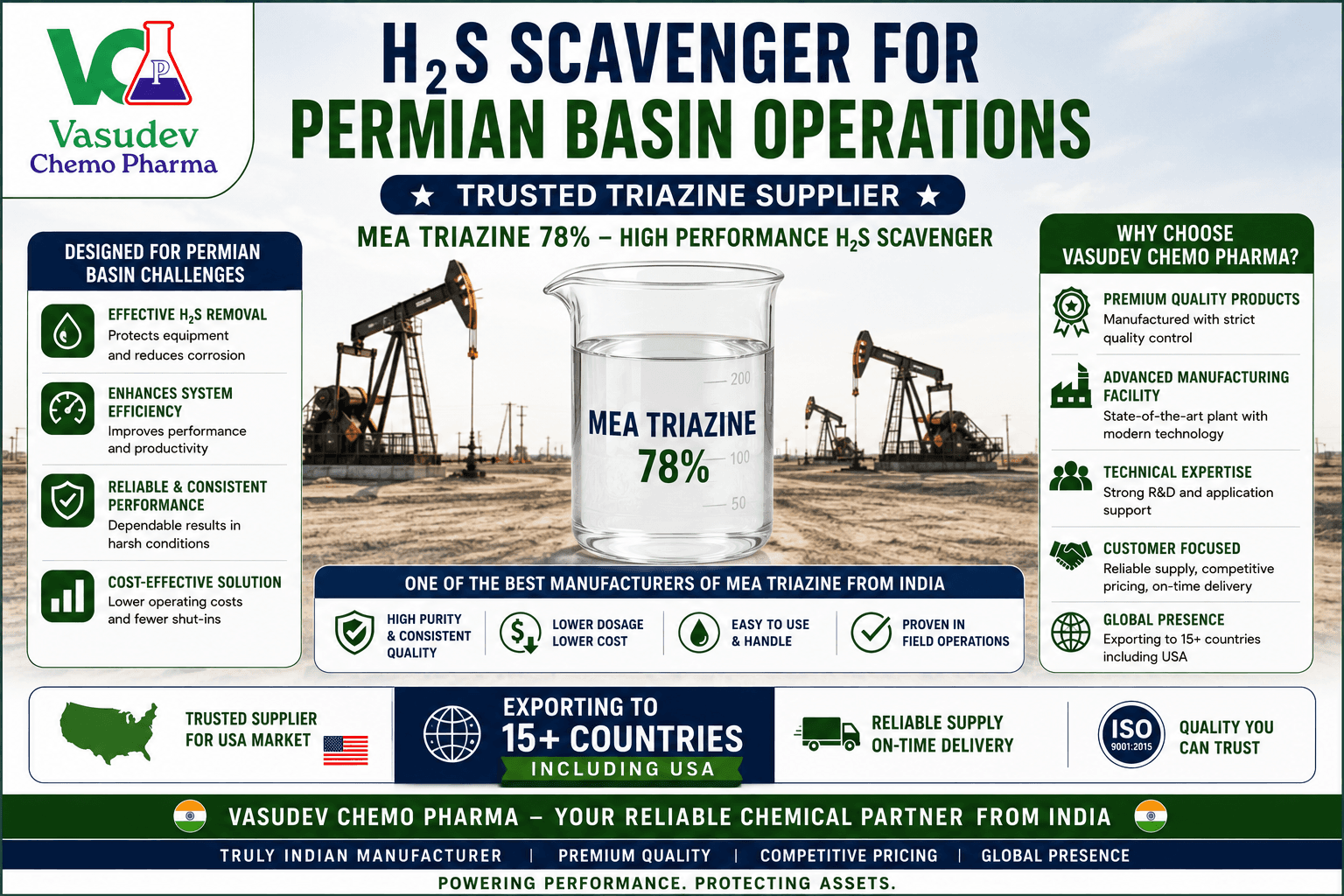
Vasudev Chemo Pharma
ISO 9001:2015 Certified Manufacturer of Industrial & Specialty Chemicals
The Permian Basin H2S Challenge
The Permian Basin produces over 5.9 million barrels of oil per day and accounts for roughly 40% of total US crude output. Sour gas containing hydrogen sulfide (H2S) is a pervasive challenge across the basin's major formations — the Wolfcamp, Bone Spring, Spraberry, and Delaware sub-basins. H2S concentrations in Permian gathering systems routinely range from 200 ppm to over 10,000 ppm, depending on formation depth and geographic location. Southern Delaware Basin wells, particularly in Reeves and Loving counties, frequently produce gas with H2S levels exceeding 5,000 ppm, requiring aggressive chemical scavenging programs to meet pipeline specifications (typically 4 ppm H2S or below). Operators who fail to manage H2S effectively face pipeline corrosion, compressor damage, regulatory penalties, and serious worker safety hazards under OSHA 29 CFR 1910.1000 exposure limits.
- Permian Basin H2S levels range from 200 ppm to 10,000+ ppm across formations
- MEA Triazine 78% provides irreversible, non-regenerable scavenging
- Simple injection infrastructure — no contactor towers required
- Approximately 3.1 gal per lb H2S removed (field-adjusted)
- Direct-manufacturer supply with Houston and Midland-Odessa distribution
Why MEA Triazine 78% Dominates Permian Basin H2S Treatment
MEA Triazine 78% has established itself as the preferred H2S scavenger for Permian Basin operations due to its irreversible reaction chemistry, water solubility, and compatibility with existing injection infrastructure. Unlike regenerable amine systems that require capital-intensive contactor towers, MEA Triazine operates as a simple chemical injection — a pump, a chemical tank, and an injection quill are all the equipment needed. The triazine reacts with H2S on contact to form dithiazine, a water-soluble, non-toxic by-product that flows through produced-water handling systems without creating disposal challenges. At 78% active concentration, the product offers the highest available reactivity per unit volume, minimizing chemical consumption and storage requirements at remote Permian well sites where space and logistics are constant constraints.
Field Deployment in Permian Gathering Systems
Permian Basin operators deploy MEA Triazine 78% at multiple injection points across their gathering systems. Wellhead injection treats H2S at the source before it enters flow lines, protecting the entire downstream infrastructure. Central gathering facility injection provides a second treatment stage where gas from multiple wells is combined and treated before entering sales-gas pipelines. Some operators use both approaches — wellhead injection to reduce H2S below equipment corrosion thresholds, followed by central facility injection to achieve pipeline-quality specifications. Injection systems typically use positive-displacement chemical pumps rated for continuous duty, with flow rates proportional to gas production and H2S concentration. Automated chemical management systems with H2S analyzers and PLC-controlled pumps optimize chemical usage and reduce over-treatment waste.
Dosing Considerations for Permian Basin Conditions
Effective triazine dosing in the Permian Basin requires consideration of several basin-specific factors. Gas flow rates fluctuate significantly during the decline curve of horizontal wells — initial production (IP) rates can exceed 20 MMscf/d before declining to 2–5 MMscf/d within 12–18 months. H2S concentrations also change over a well's life cycle and can spike during offset drilling or fracturing operations. Temperature affects reaction kinetics — summer surface temperatures in West Texas regularly exceed 110°F (43°C), accelerating the triazine-H2S reaction rate, while winter overnight temperatures in the northern Midland Basin can drop below freezing, potentially affecting chemical viscosity and injection pump performance. Industry stoichiometric calculations suggest approximately 3.1 gallons of MEA Triazine 78% per pound of H2S removed, though actual field consumption varies based on contact time, gas-liquid mixing efficiency, and the presence of competing acid gases like CO2.
Choosing a Triazine Supplier for Permian Basin Operations
Supply reliability is critical for Permian Basin H2S treatment programs. Chemical outages — even for 24 hours — can force well shut-ins, trigger pipeline alarms, and create OSHA-reportable safety events. Vasudev Chemo Pharma offers Permian Basin operators a direct-manufacturer supply chain with CIF Houston delivery and regional distribution partnerships that maintain inventory in Midland-Odessa and Pecos for rapid deployment. Each shipment includes an independent Certificate of Analysis confirming 78% active concentration, and our flexible packaging options — 200 L drums, 1,000 L IBCs, and ISO tank loads — scale to match operations ranging from single-well independents to multi-pad development programs producing 50,000+ barrels of oil equivalent per day.
"In the Permian Basin, H2S management is not optional — it is a daily operational requirement that directly impacts worker safety, asset integrity, and regulatory compliance. Choosing the right triazine scavenger supplier ensures uninterrupted production and predictable treatment costs."
Related Products & Services
Permian Basin H2S challenges demand reliable chemistry and reliable supply. Vasudev Chemo Pharma delivers MEA Triazine 78% at manufacturer-direct pricing with the logistics infrastructure to serve even the most remote Permian well sites. Whether you operate in the Delaware, Midland, or Central Basin Platform, our team provides technical support, dosing guidance, and flexible supply terms to keep your operations running safely and efficiently.