MEA Triazine vs Alternative H2S Scavengers — Complete US Market Comparison
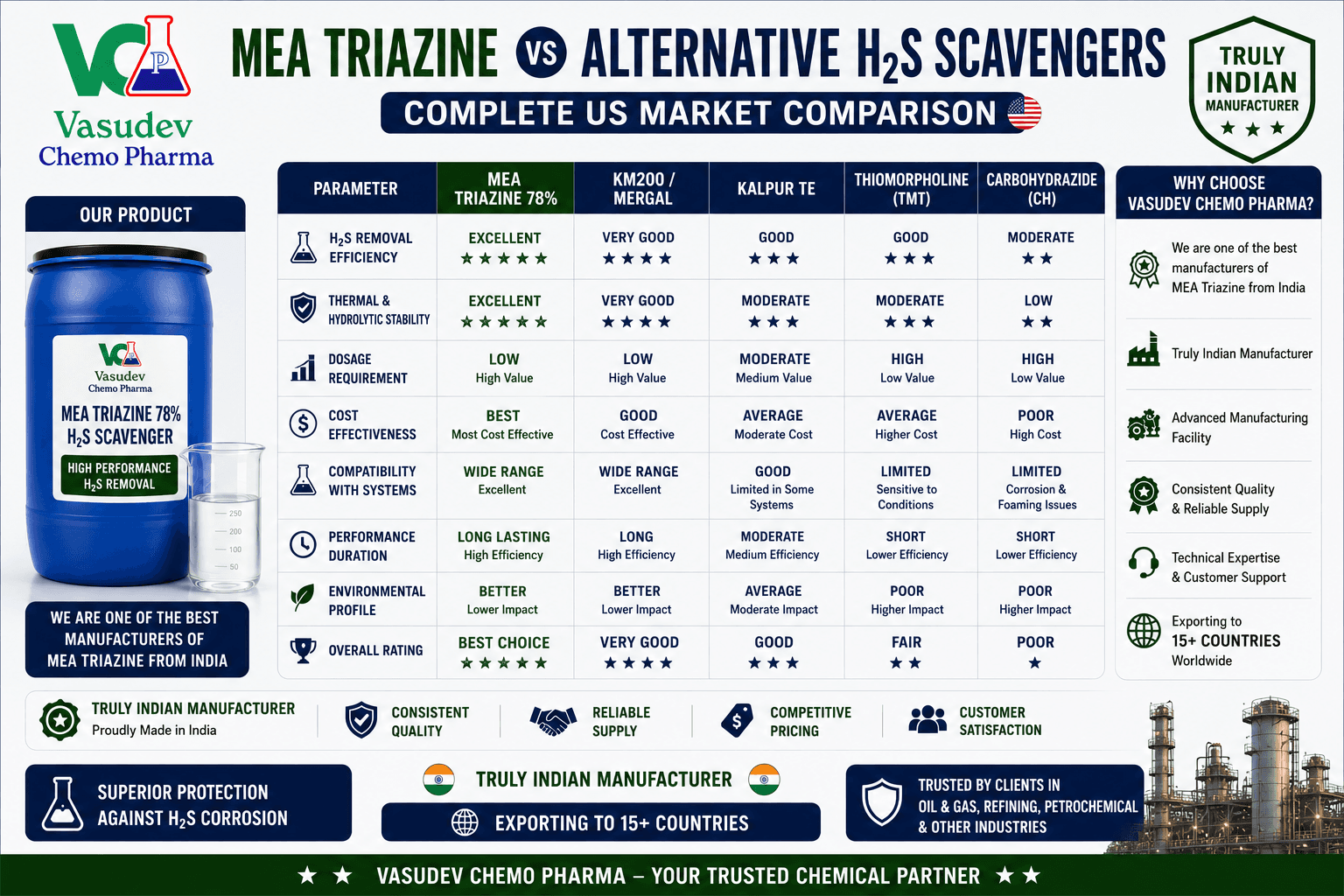
Choosing the right H2S scavenger for US oil and gas operations requires understanding the strengths and limitations of each option. This guide compares MEA Triazine 78% against MMA Triazine, glyoxal-based scavengers, iron sponge, and solid scavengers on performance, cost, and operational factors.
Vasudev Chemo Pharma
ISO 9001:2015 Certified Manufacturer of Industrial & Specialty Chemicals
Why H2S Scavenger Selection Matters for US Operators
US oil and gas operators spend an estimated $1.5–2 billion annually on H2S removal chemistry and equipment. Selecting the wrong scavenger type for a specific application leads to over-treatment, excessive chemical costs, equipment compatibility issues, and potential safety hazards. The US market offers several distinct H2S scavenger categories — liquid triazines (MEA and MMA), glyoxal-based systems, solid iron-oxide media, and specialty formulations. Each category has optimal applications, and understanding these differences enables procurement managers and field engineers to make data-driven decisions that reduce costs while maintaining treatment effectiveness. This comparison focuses on the five most widely deployed scavenger technologies in the US market, evaluated against real-world operational criteria.
- MEA Triazine 78% — most cost-effective liquid scavenger for high-volume applications
- MMA Triazine 40% — niche alternative for specific water-chemistry constraints
- Glyoxal scavengers — 20–40% price premium, suited for low-H2S biogas/landfill gas
- Iron sponge/solid media — high CAPEX, pyrophoric disposal, limited to low-flow systems
- Direct-manufacturer sourcing reduces triazine costs by 25–40% vs. service-company bundles
MEA Triazine 78% — The Liquid Scavenger Benchmark
MEA Triazine 78% (1,3,5-tris(2-hydroxyethyl)-s-triazine, CAS 4719-04-4) is the most widely used liquid H2S scavenger in the United States. It reacts irreversibly with H2S in a 1:1 molar ratio to form water-soluble dithiazine by-products. Key advantages include high reactivity at ambient temperatures, full water solubility, low toxicity, and compatibility with standard chemical injection infrastructure. MEA Triazine handles H2S concentrations from trace levels up to 10,000+ ppm in both gas-phase and liquid-phase applications. Limitations include the irreversible nature of the reaction (spent chemistry cannot be regenerated) and the potential for foaming in some gas-liquid contacting equipment. Cost-per-pound of H2S removed typically ranges from $2.50–4.50, depending on procurement source and application efficiency.
MMA Triazine 40% — Lower Concentration Alternative
MMA Triazine 40% (1,3,5-tris(2-hydroxymethyl)-s-triazine) uses a methylamine-based triazine ring instead of the monoethanolamine backbone in MEA Triazine. At 40% active concentration, MMA Triazine requires roughly twice the volume of MEA Triazine 78% to achieve the same H2S removal. MMA Triazine offers slightly different solubility characteristics and produces different by-products — some operators prefer it in applications where produced-water chemistry creates compatibility issues with MEA by-products. However, the higher volume requirement increases storage space, transportation costs, and injection pump sizing. For most US applications, MEA Triazine 78% delivers superior economics because fewer gallons treat the same H2S load. MMA Triazine 40% finds its niche in applications with specific water-chemistry constraints or where the lower active concentration provides better mixing behavior in certain contactor designs.
Glyoxal-Based Scavengers — Non-Triazine Liquid Option
Glyoxal-based H2S scavengers represent a non-triazine alternative for operators seeking to avoid triazine chemistry entirely. These products react with H2S through a different mechanism, forming thiazolidine-type compounds. Glyoxal scavengers perform well in low-H2S applications (under 500 ppm) and offer advantages in systems where triazine by-products cause issues with downstream water treatment. However, glyoxal products typically carry a 20–40% price premium over MEA Triazine on a per-pound-of-H2S-removed basis, and reaction kinetics are slower at lower temperatures. They also present higher vapor-phase toxicity concerns compared to MEA Triazine, requiring additional PPE considerations. US market share for glyoxal scavengers remains below 10%, primarily concentrated in biogas and landfill gas applications where H2S levels are moderate and produced-water chemistry favors non-triazine options.
Iron Sponge and Solid Scavengers — Fixed-Bed Alternatives
Iron-oxide-based scavengers — including iron sponge (iron-oxide-impregnated wood chips), proprietary iron-oxide pellets, and zinc-oxide media — operate as fixed-bed systems where sour gas passes through a vessel packed with reactive media. These solid scavengers excel in low-flow, moderate-H2S applications such as small wellhead separators, landfill gas systems, and biogas upgrading plants. Iron sponge offers very low per-unit chemistry costs but requires significant capital investment in vessels, piping, and media change-out infrastructure. Spent iron sponge is pyrophoric (can spontaneously ignite when exposed to air) and classified as hazardous waste in many jurisdictions, creating disposal costs and safety risks. For high-flow gas gathering systems typical of Permian Basin or Eagle Ford operations, fixed-bed scavengers become impractical due to vessel sizing requirements, pressure drop, and media replacement frequency.
Head-to-Head Comparison — Choosing the Right Scavenger
When comparing H2S scavengers for US operations, the decision depends on four key factors: H2S concentration, gas flow rate, infrastructure availability, and total cost of ownership. For high-volume gas treating above 5 MMscf/d with H2S exceeding 500 ppm, MEA Triazine 78% delivered via continuous injection is the most cost-effective and operationally simple solution. For moderate-volume applications with lower H2S (under 200 ppm) and existing vessel infrastructure, solid scavengers can offer lower ongoing chemistry costs — though capital and disposal expenses must be factored in. MMA Triazine serves as a direct alternative where MEA by-product chemistry is a concern. Glyoxal products remain a specialty option for specific water-chemistry situations. Across all scenarios, sourcing triazine chemistry directly from a manufacturer like Vasudev Chemo Pharma — rather than through a bundled service-company contract — reduces chemical costs by 25–40% without sacrificing product quality.
"The best H2S scavenger is the one that matches your specific application conditions — not the one your service company is incentivized to sell. Understanding the chemistry gives operators the power to make procurement decisions based on performance data, not sales presentations."
Related Products & Services
Selecting the optimal H2S scavenger for US oil and gas operations requires matching chemistry to application conditions. For the vast majority of upstream and midstream gas treating applications, MEA Triazine 78% delivers the best combination of treatment effectiveness, operational simplicity, and total cost. Vasudev Chemo Pharma supplies MEA Triazine 78% and MMA Triazine 40% directly to US operators, providing the product quality of major service-company chemistry at transparent manufacturer pricing.