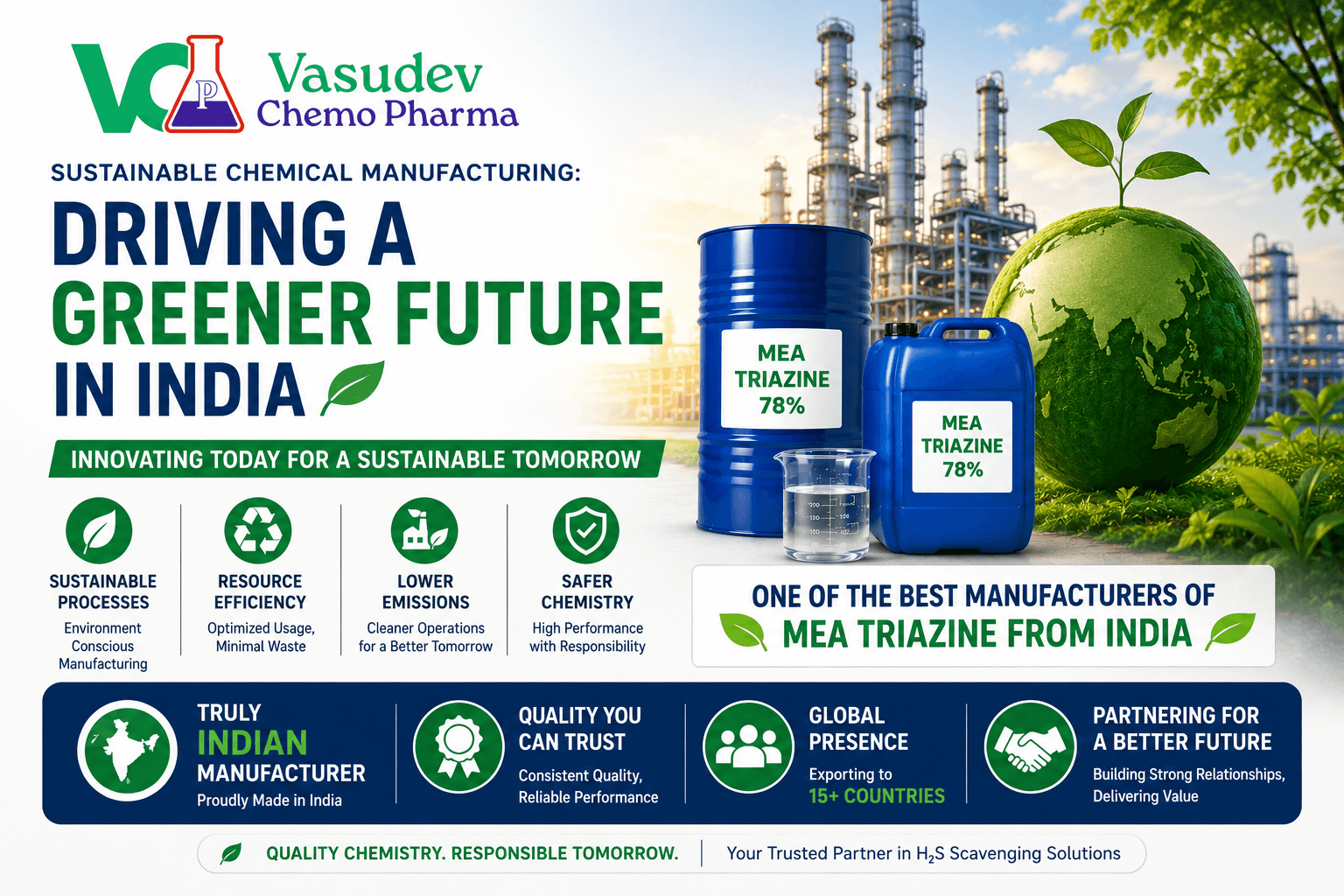
Sustainable Chemical Manufacturing: Driving a Greener Future in India
How Indian chemical manufacturers are adopting sustainable practices — from green chemistry to renewable energy — to reduce environmental impact while maintaining world-class production quality.
Vasudev Chemo Pharma
ISO 9001:2015 Certified Manufacturer of Industrial & Specialty Chemicals
The Rise of Green Chemistry in Indian Manufacturing
The Indian chemical manufacturing sector is undergoing a profound transformation as sustainability moves from aspiration to operational imperative. Green chemistry principles — designing chemical products and processes that reduce or eliminate hazardous substances — are now central to how leading manufacturers like Vasudev Chemo Pharma approach production. By re-engineering synthesis routes, selecting safer solvents, and optimising reaction conditions, manufacturers can dramatically reduce waste, energy consumption, and environmental risk without sacrificing product quality. India's chemical industry, valued at over $220 billion, accounts for roughly 7% of the nation's GDP. As global buyers increasingly demand environmentally responsible supply chains, Indian exporters who adopt sustainable manufacturing practices gain a decisive competitive advantage in international markets across the Middle East, Southeast Asia, and Africa.
- Reduced carbon footprint through renewable energy integration
- Efficient resource utilisation via green chemistry principles
- Waste minimisation with zero-liquid-discharge systems
- Improved brand reputation and access to premium international markets
Energy Efficiency and Renewable Integration
Energy costs represent one of the largest operational expenses in chemical manufacturing. Forward-thinking producers are investing in combined heat and power (CHP) systems, variable-frequency drives, and waste-heat recovery to cut energy consumption by 20–35%. Solar and wind power installations at manufacturing facilities in Gujarat and Maharashtra are becoming commonplace, offsetting grid electricity and reducing carbon footprints. Vasudev Chemo Pharma's production of specialty chemicals such as MEA Triazine and P-Toluenesulfonic Acid benefits from these efficiency gains, resulting in lower per-unit costs and a smaller environmental impact that appeals to sustainability-conscious buyers worldwide.
Waste Minimisation and Circular Economy Practices
Traditional chemical manufacturing generates significant by-products and waste streams. Sustainable manufacturers are closing the loop by recovering solvents for reuse, converting by-products into saleable co-products, and implementing zero-liquid-discharge (ZLD) systems. These circular economy practices not only reduce disposal costs and environmental liability but also create new revenue streams. Process integration, by-product recovery, and water recycling can help maximise atom economy, ensuring that more raw material ends up in saleable product rather than waste. Water recycling and treatment systems further reduce freshwater consumption, a critical concern in water-stressed regions.
Regulatory Compliance and ISO Certification
Environmental regulations in India — from the Central Pollution Control Board (CPCB) guidelines to state-level emission norms — are becoming increasingly stringent. ISO 9001:2015 and ISO 14001 certifications demonstrate a manufacturer's commitment to quality management and environmental stewardship. These certifications are not just compliance checkboxes; they signal to international buyers that a supplier operates to globally recognised standards. Sustainable manufacturing also aligns with the United Nations Sustainable Development Goals (SDGs), particularly Goal 9 (Industry, Innovation, and Infrastructure) and Goal 12 (Responsible Consumption and Production), making certified manufacturers preferred partners for multinational corporations with ESG mandates.
The Business Case for Sustainability
Sustainability is no longer at odds with profitability. Studies by McKinsey and the World Economic Forum consistently show that companies with strong ESG practices outperform peers in the long run. For chemical manufacturers, the benefits are tangible: lower raw material and energy costs, reduced regulatory penalties, improved worker safety, stronger brand reputation, and access to premium markets that demand green credentials. As global supply chains prioritise transparency and environmental responsibility, manufacturers who invest in sustainability today are positioning themselves as the preferred suppliers of tomorrow.
"Sustainable manufacturing is not a cost centre — it is a competitive advantage. Every rupee invested in green chemistry, energy efficiency, and waste reduction pays dividends in lower costs, fewer regulatory risks, and stronger customer relationships."
Related Products & Services
The transition to sustainable chemical manufacturing is accelerating across India. Manufacturers who embed green chemistry, renewable energy, circular economy practices, and ISO-certified quality systems into their operations will lead the industry. At Vasudev Chemo Pharma, sustainability is woven into every stage of production — from sourcing raw materials to shipping finished products worldwide — ensuring our customers receive world-class chemicals produced responsibly.