Triazine H2S Scavenger Dosing Guide for Oil & Gas Operations
A practical, engineer-friendly guide to calculating MEA Triazine 78% dosing rates for H2S scavenging in oil and gas operations. Covers stoichiometric fundamentals, field-adjusted calculations, injection methods, monitoring, and common dosing mistakes.
Vasudev Chemo Pharma
ISO 9001:2015 Certified Manufacturer of Industrial & Specialty Chemicals
Dosing Fundamentals — The Chemistry Behind the Calculation
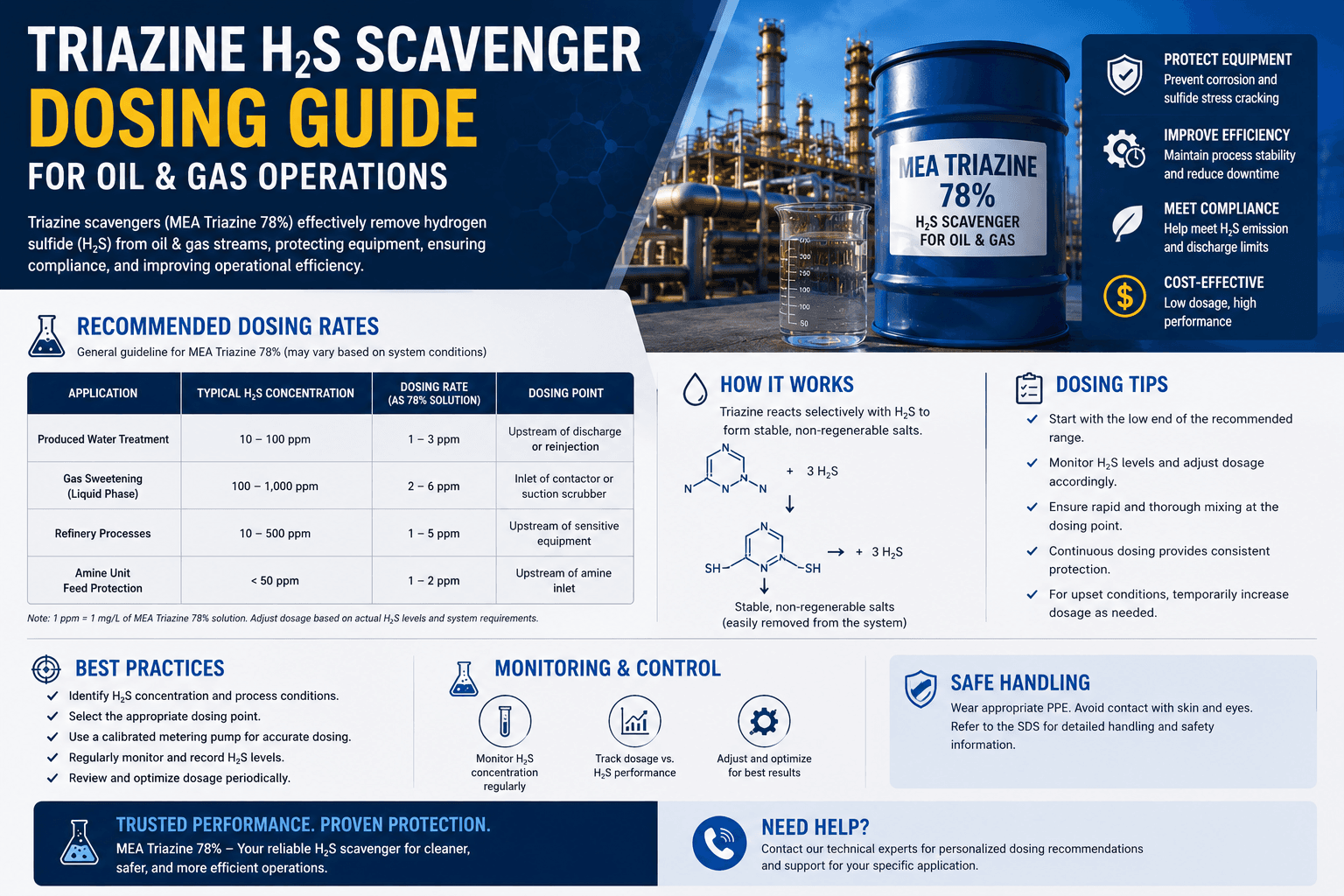
Accurate triazine H2S scavenger dosing starts with understanding the underlying reaction chemistry. MEA Triazine (1,3,5-tris(2-hydroxyethyl)-s-triazine) reacts with hydrogen sulfide in a 1:1 molar ratio — one mole of triazine neutralizes one mole of H2S to form dithiazine, a water-soluble, non-hazardous by-product. The molecular weight of the triazine active ingredient is approximately 177.2 g/mol, and H2S has a molecular weight of 34.08 g/mol. At 78% active concentration and a specific gravity of approximately 1.14 g/mL, each gallon of MEA Triazine 78% contains roughly 3.38 kg (7.45 lbs) of active triazine. This translates to a theoretical consumption of approximately 5.2 moles of triazine per mole of H2S — adjusted for the empirical observation that field conditions rarely achieve 100% stoichiometric efficiency.
- 1:1 molar ratio — one mole of triazine neutralizes one mole of H2S
- Field consumption factor: 3.1–4.5 gallons MEA Triazine 78% per pound of H2S
- Direct-pipeline injection suits most applications up to 20 MMscf/d
- Contactor towers achieve 2.5–3.0 gal/lb H2S for higher efficiency
- Monitor inlet and outlet H2S continuously to optimize chemical spend
Step-by-Step Dosing Calculation Methodology
Follow this methodology to calculate your triazine injection rate. Step 1: Determine your gas flow rate in MMscf/d (million standard cubic feet per day). Step 2: Measure the inlet H2S concentration in parts per million (ppm). Step 3: Calculate H2S mass flow — multiply gas flow (MMscf/d) × H2S concentration (ppm) × 0.0001786 to get pounds of H2S per day. Step 4: Apply the consumption factor — industry experience shows MEA Triazine 78% consumption ranges from 3.1 to 4.5 gallons per pound of H2S, depending on contact efficiency. Use 3.5 gal/lb as a starting estimate for well-designed injection systems. Step 5: Multiply H2S mass flow (lb/day) by the consumption factor (gal/lb) to get daily triazine injection rate in gallons per day. Example: A 10 MMscf/d gas stream at 1,000 ppm H2S produces approximately 17.86 lb H2S per day. At 3.5 gal/lb, the initial dosing rate is approximately 62.5 gallons of MEA Triazine 78% per day.
Injection System Types and Best Practices
Three primary injection configurations dominate US oilfield triazine applications. Direct-pipeline injection uses a chemical pump and injection quill inserted directly into the gas flow line. This is the simplest and most common method, suitable for moderate H2S levels and flow rates up to approximately 20 MMscf/d. The injection quill should be positioned in a straight pipe run, at least 10 pipe diameters downstream of any fitting or valve, and oriented to spray chemistry into the center of the flow stream. Contactor tower injection circulates triazine through a packed-bed or bubble-cap column where gas flows counter-current to the liquid scavenger. This method provides superior gas-liquid contact and higher treatment efficiency — consumption factors of 2.5–3.0 gal/lb H2S are achievable. Batch treatment involves periodic injection of triazine slugs into production vessels or storage tanks. This approach suits intermittent production or applications where continuous injection is impractical.
Monitoring and Optimization in the Field
Effective dosing requires continuous monitoring and regular adjustment. Install H2S analyzers at both the inlet and outlet of the treatment point to measure scavenging efficiency in real-time. Target an outlet H2S specification that meets your pipeline contract — typically 4 ppm or 16 ppm depending on the gas purchaser's requirements. Track daily chemical consumption against H2S removal to calculate your actual consumption factor. If consumption exceeds 4.5 gal/lb consistently, investigate the injection point design, pump calibration, and gas-liquid contact efficiency before simply increasing dosing rates. Environmental factors directly affect dosing performance: gas temperature above 100°F (38°C) accelerates the reaction and can improve efficiency, while temperatures below 60°F (15°C) slow reaction kinetics and may require higher dosing or longer contact times. The presence of CO2 in the gas stream does not significantly affect triazine performance — MEA Triazine is H2S-selective and does not react with carbon dioxide under field conditions.
Common Dosing Mistakes and How to Avoid Them
Field experience reveals several recurring triazine dosing errors that increase costs without improving treatment effectiveness. Over-dosing occurs when operators set chemical pump rates based on initial peak H2S levels and never reduce them as wells decline — resulting in unnecessary chemical consumption of 20–40% above actual requirements. Under-dosing happens when operators cut chemical rates too aggressively during cost-reduction campaigns, leading to H2S exceedances that trigger pipeline shutdowns and penalties far exceeding the chemical savings. Poor injection point selection — placing quills in turbulent zones, dead legs, or immediately after fittings — reduces gas-liquid contact time and drives up consumption factors. Inconsistent chemical supply creates gaps in treatment that allow H2S slugs to reach downstream equipment. Finally, using triazine products with lower-than-specified active concentration (a common issue with unverified suppliers) inflates apparent consumption because the effective dosing rate per gallon is reduced.
Sourcing Consistent-Quality Triazine for Reliable Dosing
Dosing accuracy depends on consistent product quality. If the active concentration of your triazine supply varies from batch to batch, your dosing calculations become unreliable and field operators lose confidence in the treatment program. Vasudev Chemo Pharma maintains strict quality control on every batch of MEA Triazine 78% — independent Certificates of Analysis confirm active concentration, specific gravity, pH, and appearance against international specifications. This batch-level consistency means your dosing calculations remain valid throughout the consumption of each delivery. Our direct-manufacturer supply model eliminates the risk of re-blended or diluted product that occasionally occurs with multi-tier distribution chains. Contact our technical team for basin-specific dosing recommendations based on your gas composition, flow rates, and treatment targets.
"The difference between a well-optimized triazine program and a poorly managed one can be 30–40% in annual chemical spend — without any change in treatment effectiveness. Accurate dosing starts with reliable chemistry and disciplined field monitoring."
Related Products & Services
Optimizing triazine H2S scavenger dosing rates is one of the highest-ROI activities available to US oil and gas operators. By understanding the stoichiometric fundamentals, selecting the right injection method, monitoring performance continuously, and sourcing consistent-quality MEA Triazine 78% from a verified manufacturer, operators can achieve reliable H2S treatment at the lowest sustainable cost. Vasudev Chemo Pharma provides both the chemistry and the technical support to help operators maximize their scavenging program efficiency.