What is MEA Triazine and Why is it the Best H2S Scavenger for Oil & Gas?
MEA Triazine 78% is the most widely used liquid H2S scavenger in the oil and gas industry. Learn what it is, how it works, why it outperforms alternatives, and how to source it directly from an ISO-certified Indian manufacturer.
Vasudev Chemo Pharma
ISO 9001:2015 Certified Manufacturer of Industrial & Specialty Chemicals
What is MEA Triazine?
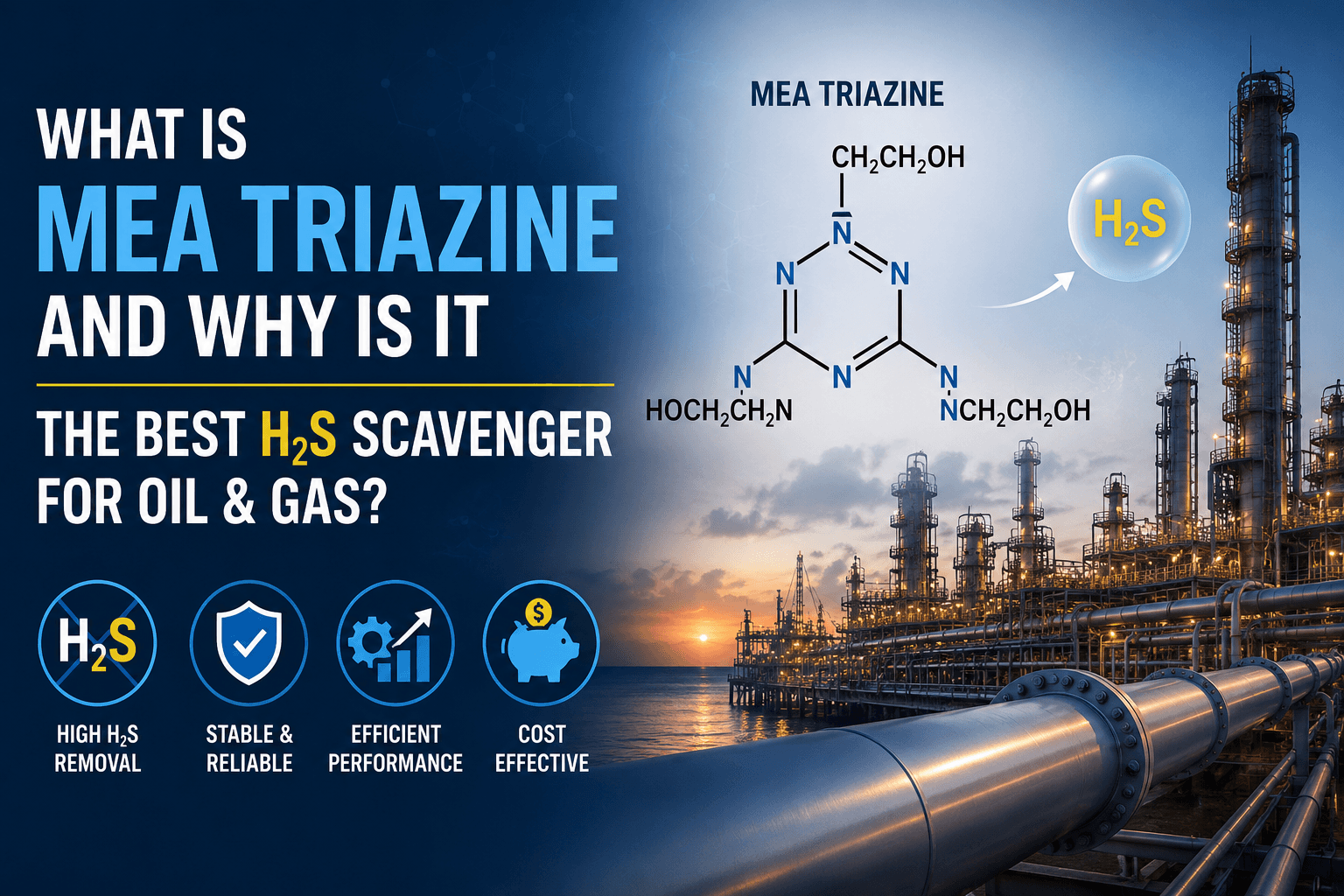
MEA Triazine — formally known as 1,3,5-tri(2-hydroxyethyl)-hexahydro-s-triazine — is a water-soluble organic compound with the CAS number 4719-04-4. It belongs to the hexahydrotriazine family, a class of chemicals formed by the condensation reaction between formaldehyde and an amine, in this case monoethanolamine (MEA). The result is a clear to slightly yellow liquid with a mild amine odour, typically supplied at 78% active concentration in aqueous solution. MEA Triazine was first adopted by the oil and gas industry in the 1980s as a cost-effective alternative to amine scrubbing systems for removing hydrogen sulfide (H2S) from gas and liquid streams. Unlike regenerative amine systems that require expensive absorber-stripper column infrastructure, MEA Triazine is a non-regenerable, once-through scavenger — you inject it, it reacts with H2S, and the spent product is disposed of with produced water. This simplicity is precisely what made MEA Triazine the dominant H2S scavenging chemistry worldwide, and it remains so today despite decades of attempts by competitors to develop alternatives.
- 78% active concentration — highest scavenging capacity per litre
- Irreversible reaction: H2S → water-soluble, non-toxic dithiazine
- Compatible with standard injection equipment and produced water systems
- 40+ years of proven field performance across global oil & gas operations
- Direct-manufacturer pricing eliminates intermediary markups
- ISO 9001:2015 certified with full COA, TDS, MSDS documentation
The Chemistry: How MEA Triazine Removes H2S
The reaction between MEA Triazine and hydrogen sulfide is an irreversible nucleophilic substitution. When H2S contacts the triazine molecule, the sulphur atom attacks the carbon centres in the triazine ring, progressively replacing nitrogen atoms. The reaction proceeds in steps: the first mole of H2S converts triazine to a mono-thio intermediate, the second mole produces dithiazine, and a third mole can form trithiane under excess H2S conditions. The simplified overall reaction is: Triazine + 3 H2S → Dithiazine + Trithiane + 3 MEA. The by-products — dithiazine and trithiane — are water-soluble and non-toxic, making them compatible with standard produced-water disposal systems. The released monoethanolamine is also water-soluble and biodegradable. This clean reaction profile is a significant advantage over iron-based scavengers that generate solid iron sulphide waste requiring special handling and disposal. The reaction stoichiometry means each mole of MEA Triazine can theoretically scavenge up to 3 moles of H2S. In practice, the effective ratio depends on contact efficiency, temperature, pH, and the presence of competing species like CO2. Under typical oilfield conditions, operators achieve 60–80% of theoretical efficiency, which translates to approximately 4.5 litres of MEA Triazine 78% per kilogram of H2S removed.
Why MEA Triazine 78% Outperforms Alternative H2S Scavengers
The oil and gas industry has evaluated numerous H2S scavenging chemistries over the decades. Here is why MEA Triazine 78% consistently emerges as the preferred choice. First, concentration and efficiency: at 78% active content, MEA Triazine delivers the highest scavenging capacity per litre of any commercially available liquid scavenger. This means less product to ship, store, and inject — directly reducing logistics costs and chemical inventory requirements. Glyoxal-based scavengers typically operate at 40–50% active content and require higher dosage rates to achieve equivalent H2S removal. Second, reaction speed: the triazine-H2S reaction is fast at ambient temperature and accelerates further at elevated temperatures common in oilfield operations (40–80°C). Iron-based liquid scavengers like ferric chloride can be slow to react and generate problematic iron sulphide solids. Third, clean by-products: the water-soluble, non-toxic reaction products of MEA Triazine eliminate the solid waste disposal problems associated with iron sponge and iron oxide scavengers. Fourth, compatibility: MEA Triazine is compatible with standard chemical injection equipment, produced water systems, and downstream treatment processes. It does not cause emulsion problems, does not interfere with demulsifier performance, and does not foul equipment surfaces. Fifth, proven track record: with over four decades of field use across every major oil and gas producing region — from the Permian Basin to the Middle East to offshore platforms in the North Sea — MEA Triazine has an unmatched performance database. Operators and engineers trust it because it works reliably across a wide range of conditions.
Where MEA Triazine is Used in Oil & Gas Operations
MEA Triazine 78% is deployed across the entire oil and gas value chain. In upstream operations, it is injected at the wellhead or into gathering lines to protect downstream infrastructure from H2S corrosion and to meet pipeline H2S specifications. Continuous chemical injection pumps deliver a controlled flow of MEA Triazine proportional to the gas flow rate and H2S concentration. In midstream operations, MEA Triazine is used in gas processing facilities — particularly in bubble towers and spray towers where gas-liquid contact is optimised for H2S removal. Midstream operators processing sour gas from multiple wells often consume large volumes of triazine on a continuous basis, making direct-manufacturer procurement a significant cost advantage. In downstream operations, refineries use MEA Triazine for treating off-gases from crude distillation, hydrotreating, and coking units where H2S is generated as a process by-product. Tank vapour treatment and crude oil stabilisation are additional applications. Beyond traditional oil and gas, MEA Triazine finds growing application in biogas and landfill gas treatment, where H2S must be removed to meet pipeline injection or power generation specifications. The chemistry is the same — only the source of H2S differs.
How to Source MEA Triazine: Direct Manufacturer vs Distributors
The MEA Triazine supply chain in most markets involves multiple intermediaries between the manufacturer and the end user. Large oilfield service companies bundle triazine chemistry with field services and equipment rentals, adding significant markups. Regional chemical distributors add their own margins. By the time MEA Triazine reaches the wellsite, the end user may be paying 40–60% more than the ex-works manufacturing cost. Direct procurement from the manufacturer eliminates these layers. Vasudev Chemo Pharma manufactures MEA Triazine 78% at our ISO 9001:2015 certified facility in Ankleshwar, Gujarat, India — strategically located near Kandla, Mundra, and Hazira ports for efficient export logistics. We supply directly to operators, midstream companies, and chemical distributors worldwide, offering FOB and CIF pricing, batch-level Certificates of Analysis, and flexible packaging in 220-litre drums, 1000-litre IBCs, or bulk tanker quantities. Direct sourcing is particularly advantageous for operators with predictable, ongoing triazine consumption — monthly or quarterly supply contracts provide price stability and guaranteed availability, eliminating the supply chain uncertainty that comes with sourcing through intermediaries.
Quality, Documentation, and Compliance
Every batch of MEA Triazine 78% manufactured by Vasudev Chemo Pharma undergoes rigorous quality testing before release. Key parameters tested include active concentration (target: 78% ± 1%), pH, specific gravity, colour, and formaldehyde content. Each shipment is accompanied by a Certificate of Analysis (COA), Technical Data Sheet (TDS), and Material Safety Data Sheet (MSDS) / Safety Data Sheet (SDS). For export to regulated markets, we provide GHS-compliant documentation, TSCA inventory confirmation (for US imports), and REACH-compliant safety data as required. Our ISO 9001:2015 quality management system ensures full batch traceability from raw material receipt through finished product dispatch. This documentation trail is essential for operators who must demonstrate supply chain quality to regulators, insurers, and joint venture partners. Free samples are available for laboratory qualification and field testing before committing to production volumes.
"MEA Triazine 78% remains the gold standard for liquid H2S scavenging in oil and gas — not because there are no alternatives, but because no alternative consistently matches its combination of efficiency, simplicity, clean by-products, and cost-effectiveness."
Related Products & Services
MEA Triazine 78% has earned its position as the industry-standard H2S scavenger through four decades of reliable performance in the most demanding oil and gas environments on earth. Whether you are treating sour gas at a remote wellhead, processing high-H2S gas at a midstream facility, or managing off-gas at a refinery, MEA Triazine delivers consistent, cost-effective H2S removal with minimal operational complexity. Contact Vasudev Chemo Pharma to request a free sample, receive a quotation, or discuss your specific H2S treatment challenge with our technical team.