H2S Scavenger Application Methods: Injection, Contact Towers & Batch
H2S removal using scavengers depends as much on the application method as the chemical. This guide details the main triazine application methods — direct injection, contact towers, and batch treatment — and how each affects efficiency and cost.
Vasudev Chemo Pharma Technical Team
ISO 9001:2015 Certified Manufacturer of Industrial & Specialty Chemicals
Why the Application Method Determines Efficiency
H2S removal using scavengers is only as good as the contact between the chemical and the hydrogen sulfide. A triazine scavenger has a fixed theoretical capacity, but how much of that capacity you actually use depends entirely on the application method — the way the chemical is introduced and mixed with the stream. Poor contact means unreacted triazine leaves the system, wasting chemical and money; good contact approaches theoretical utilisation and minimises cost. The three dominant methods — direct injection, contact towers, and batch treatment — sit on a spectrum from simple-but-less-efficient to more-complex-but-highly-efficient. Choosing the right one is a trade-off between capital, operating simplicity, and chemical cost for a given H2S load.
- Application method, not just chemistry, sets real-world efficiency
- Direct injection: simplest, best for wellheads; ~40–60% utilisation
- Contact towers: highest efficiency for continuous high-volume gas
- Batch treatment: tanks and intermittent/low-volume streams
- Optimise with mixing, temperature/pH control, and inlet/outlet monitoring
Direct (Continuous) Injection
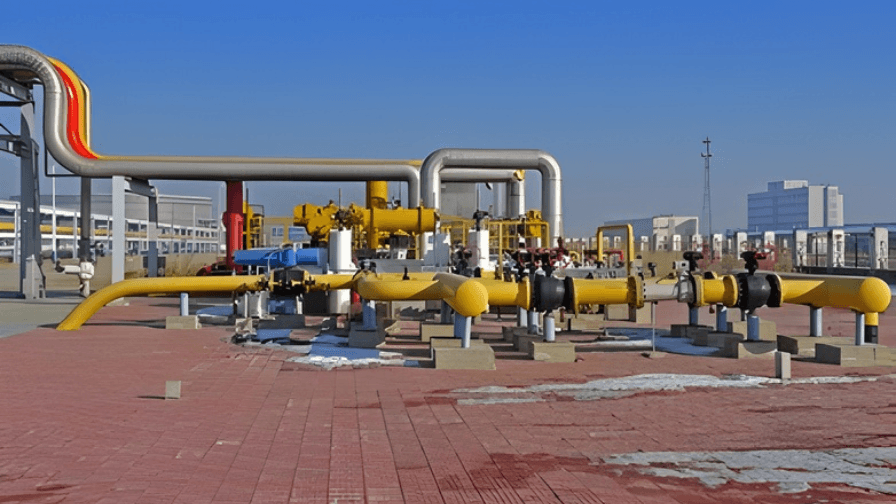
Direct injection is the simplest and most common method: a metering pump delivers liquid triazine through an injection quill into a flowing gas or liquid line, dosed in proportion to flow rate and H2S concentration. It needs minimal equipment — pump, tank, and quill — making it ideal for wellheads, gathering lines, and remote or unmanned sites. Its limitation is contact time: in a fast-flowing line, the scavenger may have only seconds to react, so utilisation is often 40–60% of theoretical, requiring a higher excess factor. Efficiency improves markedly with an atomising quill and an in-line static mixer, which disperse the chemical and extend effective contact. Direct injection is the default choice where simplicity and low capital matter more than squeezing out maximum chemical efficiency.
Contact Towers and Gas-Liquid Contactors
Contact towers maximise efficiency by forcing intimate gas-liquid contact. In a bubble tower, sour gas bubbles up through a column of triazine solution; in a spray or packed contactor, gas and chemical meet over a large surface area. The extended residence time and high interfacial area push utilisation much closer to theoretical, cutting chemical consumption per kilogram of H2S removed. This makes towers the preferred method for midstream and gas-processing facilities with consistent, higher-volume sour-gas flows, where the capital cost of the vessel is repaid by chemical savings. The trade-offs are higher upfront cost, a larger footprint, and the need to manage foaming and spent-solution handling — which is why defoamer-enhanced formulations and spent-triazine monitoring often accompany tower operation.
Batch Treatment
Batch treatment applies scavenger to a fixed volume rather than a continuous flow. It suits storage tanks, where triazine is added to control vapor-phase H2S in the headspace, and intermittent or low-volume streams where continuous injection is not justified. Batch dosing is also used to knock down H2S in stored crude or produced water before transfer. The method is simple and flexible but less precise: because H2S continues to evolve from the liquid, the dose must account for ongoing generation over the holding period, and periodic monitoring is needed to confirm the headspace stays safe. Batch treatment is often combined with continuous injection elsewhere in the system rather than used as the sole method.
Selecting and Optimising the Right Method
Method selection follows the stream: continuous high-volume gas favours a contact tower for chemical efficiency; remote or low-volume points favour direct injection for simplicity; tanks and intermittent streams favour batch treatment. Many operations combine methods — tower treatment at the plant, injection at the wellheads, batch dosing at storage. Whatever the method, optimisation levers are the same: improve mixing (static mixers, atomising quills, packing), control temperature and pH within favourable ranges, monitor inlet and outlet H2S to trim the dose, and watch for solids or foaming. Because the right method and dose are stream-specific, a bench titration plus a monitored field trial is the surest way to lock in efficient, cost-effective H2S removal. Our technical team can advise on method selection and dosing for your configuration.
The same litre of triazine can remove twice as much H2S in a well-designed contact tower as in a bare injection quill — application method is where chemical budgets are won or lost.
Related Products & Services
Effective H2S removal using scavengers is a partnership between the right chemistry and the right application method. Match direct injection, contact towers, or batch treatment to your stream, then optimise mixing and monitoring to control chemical cost. For help selecting a method and setting a dose — and to source MEA Triazine 78% — contact the Vasudev Chemo Pharma technical team.